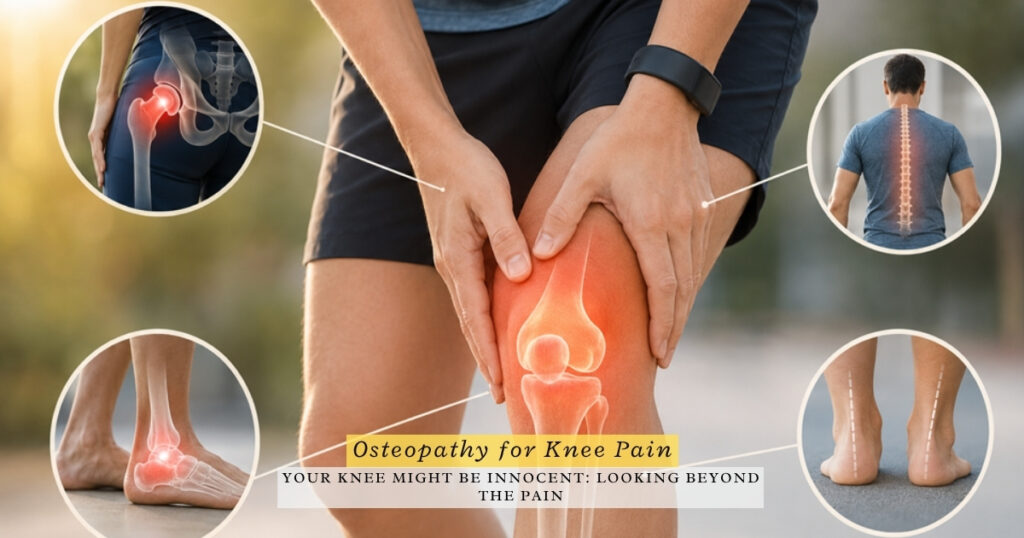
Your Knee Might Be Innocent: Looking Beyond the Pain
Most people with knee pain focus all their attention on the knee.
It makes sense. That’s where the pain is.
But what if the knee isn’t actually the problem?
At Healing Hands Healthcare, we often explain to patients that the body works as a connected system. Sometimes the area that hurts is simply the area that has been working the hardest to compensate for something happening elsewhere.
In many cases, chronic knee pain is less about the knee itself and more about what’s happening above it, below it, or around it.
Following the Clues
Imagine your body as a chain.
If one link becomes restricted, weak, or out of balance, the surrounding links must work harder to keep everything moving.
Your knee sits directly between the hips and feet, making it particularly vulnerable to these compensations.
A stiff hip may change how you walk.
A weak glute muscle may reduce stability.
Limited ankle movement may alter the way force travels through the leg.
Even something as simple as standing unevenly can gradually increase stress on the knee joint.
Over time, the knee becomes the area that complains the loudest.
What Your Feet Are Telling Your Knees
Every step begins at the feet.
Your feet absorb impact, provide balance, and help guide movement through the entire body.
When foot mechanics change, the effects can travel upward through the legs.
For example, if your foot rolls inward excessively or loses stability, the knee may also shift inward, creating additional strain on muscles, tendons, and ligaments.
This is one reason why some people continue experiencing knee pain despite focusing solely on the knee itself.
The Role of the Hips
Healthy hips help control movement throughout the lower body.
When hip mobility decreases or the surrounding muscles become weak, the knee is often forced to take on extra work.
This can be particularly noticeable during:
Running
Climbing stairs
Long walks
Exercise and sport
The body will always find a way to keep moving, but those compensations can sometimes create ongoing stress and discomfort.
The Posture Connection
Posture isn’t just about standing up straight.
It’s about how your body distributes weight throughout the day.
Many people unknowingly place more weight on one side, lock their knees while standing, or shift their posture after a previous injury.
Over months or years, these habits can place repeated strain on certain joints, including the knees.
Small imbalances repeated thousands of times can eventually become significant contributors to pain.
Looking at the Bigger Picture
This is where osteopathy takes a different approach.
Rather than asking only, “What’s wrong with the knee?” we ask:
How is the whole body moving?
Where is extra strain being created?
What compensation patterns have developed?
Which areas may need support?
Treatment may focus on improving mobility, restoring balance, reducing tension, and helping the body move more efficiently as a whole.
Because when the body works together more effectively, the knee often doesn’t have to work so hard.
Final Thoughts
Pain doesn’t always tell the whole story.
Sometimes knee pain is really a sign that another area of the body needs attention.
By understanding the relationship between the feet, hips, posture, and movement patterns, we can gain a clearer picture of what’s contributing to discomfort and what may help create lasting improvement.
At Healing Hands Healthcare, we believe the best outcomes happen when we look beyond symptoms and understand how the whole body works together.
After all, the knee is rarely working alone.